When to Worry About Pain: A Physiotherapist's Guide
You feel a twinge in your lower back reaching for your coffee. Your knee aches after yesterday's run. Your shoulder protests when you lift your arm overhead. Pain happens—it's part of being human, part of moving through the world in a body that's constantly adapting to demands we place on it.
But here's the question that keeps people awake at night: Is this pain normal, or is something seriously wrong?
As a physiotherapist, I've seen how this uncertainty creates its own suffering. People ignore warning signs that need attention, while others catastrophize benign aches into imagined disasters. Both responses stem from the same problem: not knowing what to look for.
Here's what I'd suggest: understanding pain isn't about becoming your own doctor. It's about recognizing patterns that warrant professional eyes on your situation versus those that respond well to self-management. From a movement perspective, this knowledge transforms anxiety into agency. Let me walk you through the framework I use every day in clinical practice—the same red flag system that guides our clinical decision-making and helps distinguish between 'let's monitor this' and 'you need to be seen now.'
Why Pain Assessment Matters
Pain is your body's communication system. It's sophisticated, nuanced, and frequently misunderstood. The critical insight from pain science research over the past two decades is this: pain doesn't equal damage. Not always. Not even usually.
Your nervous system produces pain as a protective response, a warning signal that something might need attention. Sometimes that something is tissue injury. Sometimes it's fatigue, stress, or a movement pattern your body finds threatening. The research consistently shows that most musculoskeletal pain is benign and self-limiting—it improves with time, appropriate activity modification, and understanding.
:::note Approximately 85-90% of acute musculoskeletal pain episodes resolve within 6-12 weeks with or without intervention. Your body has remarkable healing capacity. :::
But certain pain patterns tell a different story. They signal pathology that requires medical screening—nerve compression, fractures, infections, or systemic disease. Understanding these patterns doesn't create anxiety; it dissolves it. You're no longer guessing. You're assessing, just as we do clinically.
This knowledge empowers better healthcare decisions. You'll know when to rest, when to move, when to monitor, and when to seek help. You'll avoid both the trap of ignoring warning signs and the equally problematic trap of catastrophizing every ache. That's the purpose here: giving you a framework that serves your wellbeing.
The Red Flag Framework: What Research Tells Us
Red flags are evidence-based warning signs developed through decades of clinical research and diagnostic accuracy studies. They're not arbitrary. They represent patterns that, when present, increase the probability of serious underlying pathology enough to warrant professional screening.
Here's what's important to understand: the presence of a red flag doesn't guarantee serious pathology. It shifts probability. In my experience with similar presentations, I've seen countless red flag screenings that ultimately reveal benign conditions. That's exactly what we want—to catch the few serious cases while reassuring the many who are safe.
The framework organizes warning signs into key categories: neurological (nerve and spinal cord), systemic (infection, cancer, inflammatory disease), trauma-related (fractures, serious tissue damage), and progressive patterns (worsening despite appropriate management). Each category has its own urgency level and clinical pathway.
:::tip Think of red flags on a spectrum: some mean 'seek emergency care now' (like sudden bowel/bladder loss), others mean 'schedule an appointment this week' (like unexplained weight loss with back pain), and still others mean 'mention this at your next planned visit.' :::
The difference between 'see someone soon' versus 'seek immediate care' comes down to two factors: the potential for rapid deterioration and the time-sensitivity of intervention. Cauda equina syndrome (spinal cord compression) has a narrow treatment window—hours to days matter for outcomes. Osteoporotic fracture screening, while important, can typically wait for a scheduled appointment.
What we know about tissue healing is that early, appropriate intervention often improves outcomes. Red flag screening isn't about creating panic—it's about ensuring the right people get the right care at the right time.
Neurological Red Flags: When Nerves Are Involved
Neurological red flags represent some of the most time-sensitive warning signs in musculoskeletal care. These patterns suggest nerve root compression, spinal cord involvement, or other neurological pathology that may require urgent intervention.
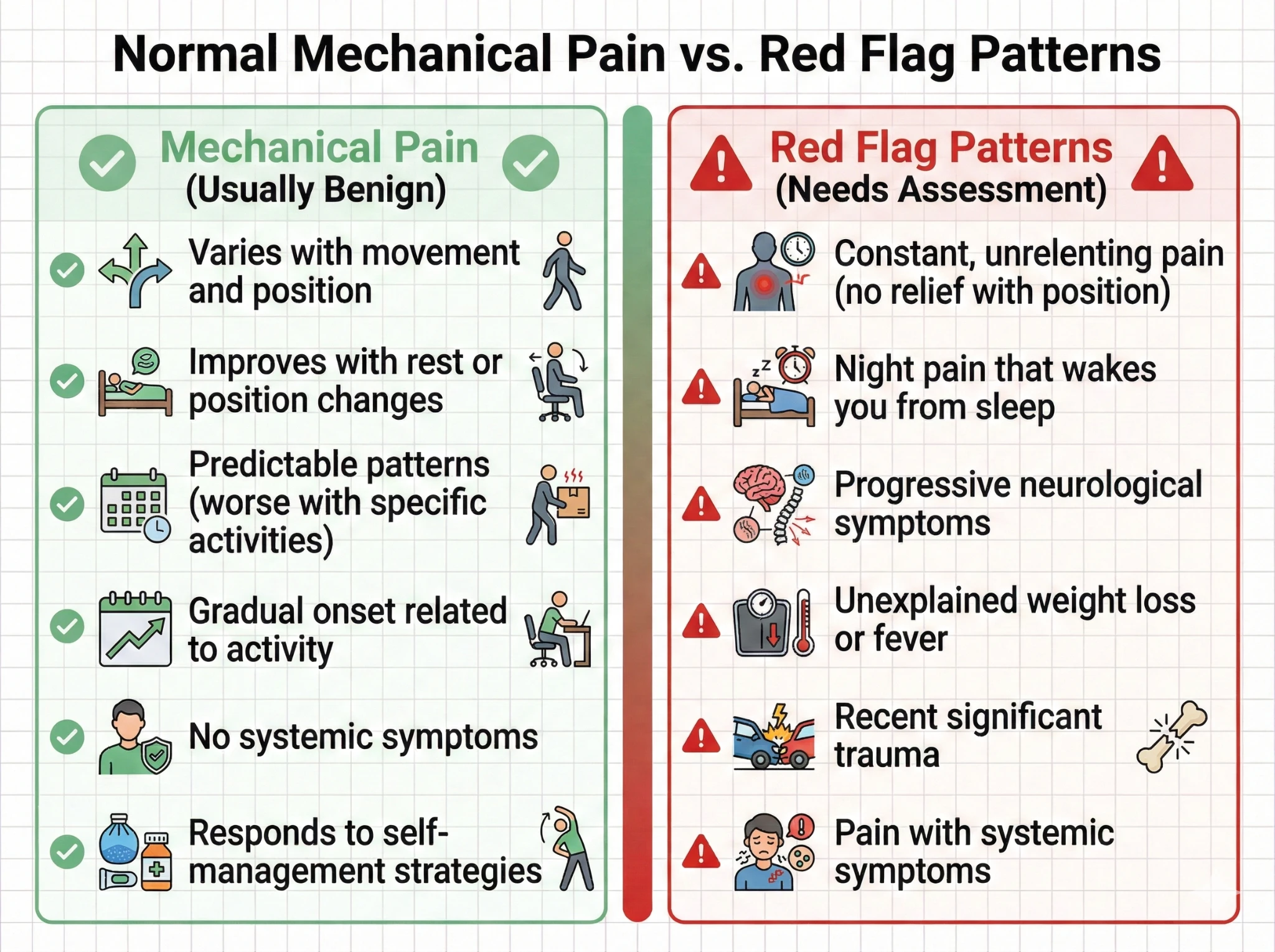
Progressive weakness or numbness that's worsening or spreading is a key warning sign. I'm not talking about temporary pins and needles that resolve when you change position—that's mechanical nerve irritation and typically benign. I mean weakness that's getting worse day by day, numbness that's expanding in distribution, or loss of function that's progressing despite rest and activity modification.
:::warning Sudden loss of bowel or bladder control (inability to urinate, loss of sensation when wiping, or inability to control bowel movements) is a medical emergency. This suggests cauda equina syndrome—compression of the nerve roots at the base of your spinal cord. If this occurs with back pain and leg symptoms, you need emergency care within hours, not days. :::
Coordination changes, difficulty walking, or balance issues that appear suddenly or worsen rapidly also warrant prompt evaluation. If you're stumbling more than usual, having trouble with fine motor tasks you normally handle easily, or noticing that your legs don't respond quite right, these patterns need professional eyes.
Why the urgency? Nerve tissue has a healing window. Prolonged compression can lead to permanent damage. Early decompression—whether through positioning, medication, or surgery—often prevents long-term neurological deficits. From a movement perspective, protecting nerve function protects your future capacity for pain-free activity.
Systemic and Medical Red Flags
Some pain patterns point beyond the musculoskeletal system to systemic disease—infections, tumors, inflammatory conditions, or metabolic disorders. These red flags require medical screening, not just physiotherapy management.
Unexplained weight loss, fever, or night sweats accompanying your pain shifts the clinical picture significantly. We're talking about unintentional weight loss (more than 5-10 pounds without trying), persistent low-grade fever, or drenching night sweats that require changing clothes or sheets. These constitutional symptoms suggest your body is fighting something systemic.
Pain that's constant, unrelenting, and unaffected by position or movement is another key warning. Mechanical musculoskeletal pain varies—it's worse with certain movements, better with others, and typically eases somewhat with rest. Pain from tumors, infections, or inflammatory disease often doesn't follow these patterns. It's there when you're still, when you're moving, when you're lying down.
:::tip Before your appointment, track your pain pattern for 2-3 days: Does anything make it better or worse? Does rest help? Does movement change it? This information is gold for clinical decision-making. :::
Your medical history matters here. History of cancer (even if years ago), osteoporosis, prolonged steroid use (like prednisone for asthma or autoimmune conditions), or immunosuppression (from medication or disease) all increase the probability that new pain might represent serious pathology. These aren't automatic red flags, but they warrant lower thresholds for screening.
Pain following significant trauma—relative to your age and activity level—also requires evaluation. A 25-year-old falling off a bike needs different consideration than a 75-year-old with osteoporosis experiencing the same fall.
What Normal Pain Actually Looks Like
Understanding red flags is only half the picture. You also need to recognize what normal, benign pain looks like—because most pain you experience will fall into this category.
Mechanical pain varies with movement, position, and activity level. Your back hurts more when you bend forward but eases when you straighten up. Your knee aches after running but feels better after rest. Your shoulder protests overhead reaching but tolerates lower activities. These patterns tell us the pain is related to mechanical load and movement, not systemic disease.
Expected post-exercise soreness follows predictable patterns. Delayed onset muscle soreness (DOMS) typically peaks 24-48 hours after novel or intense exercise, then gradually resolves over 3-5 days. It's bilateral (both sides), diffuse (not pinpoint), and improves with gentle movement and warm-up. This is your muscles adapting to new demands—uncomfortable but completely normal.
:::keytakeaway Tissue healing progresses through predictable phases: acute inflammation (0-72 hours), proliferation (3 days to 3 weeks), and remodeling (3 weeks to 12+ months). Some discomfort during each phase is normal and even necessary—it's your body's repair process at work. :::
Here's something many people don't realize: some pain during recovery is normal and even necessary. As you return to activity after injury, you'll experience some discomfort as tissues adapt to increasing loads. The key is that this pain should be manageable (not severe), should settle within 24 hours, and shouldn't progressively worsen. We call this the 'traffic light' system: green light pain (mild, settles quickly) is okay to work through; red light pain (severe, lasting, worsening) means you need to modify your approach.
Your Action Plan: From Assessment to Decision
Now you have the framework. Let's make it actionable.
Immediate emergency care (call 911 or go to ER): sudden loss of bowel/bladder control with back pain, chest pain with shortness of breath, severe trauma with suspected fracture, sudden severe headache unlike any you've experienced, or rapidly progressive neurological symptoms.
Urgent care or same-day appointment (within 24-48 hours): progressive weakness or numbness, unexplained fever with pain, significant trauma in someone with osteoporosis, or pain with constitutional symptoms (weight loss, night sweats).
Scheduled appointment (within 1-2 weeks): pain persisting beyond expected healing timeframes, pain not responding to appropriate self-management, or presence of medical red flags without acute urgency.
:::tip Before your appointment, track three things: timeline (when did this start, how has it changed?), pattern (what makes it better or worse?), and severity changes (is it improving, stable, or worsening?). This information helps your provider make accurate assessments quickly. :::
While seeking guidance, stay active within your tolerance. Complete rest is rarely the answer for musculoskeletal pain. Modify activities that aggravate symptoms, but maintain movement that feels manageable. Movement is medicine—it promotes healing, maintains function, and prevents deconditioning.
You're not alone in this process. This framework gives you the beginning of a new understanding about your body's signals. Trust your assessment, but also trust that seeking professional guidance when patterns warrant it is the wise path forward.
Conclusion
Pain assessment isn't about becoming your own diagnostician. It's about developing literacy in your body's language—understanding which messages are routine communications and which are urgent alerts requiring professional interpretation.
The red flag framework gives you that literacy. You now know that most pain is benign, self-limiting, and responds well to appropriate activity modification and time. You also know the specific patterns that warrant professional screening: progressive neurological symptoms, constitutional signs suggesting systemic disease, significant trauma, and pain that doesn't follow mechanical patterns.
This knowledge serves two purposes: it prevents you from ignoring warning signs that need attention, and it prevents you from catastrophizing normal healing responses. Both matter for your wellbeing.
Here's what I want you to remember: your body has remarkable healing capacity. Most pain improves with understanding, appropriate movement, and time. When it doesn't, or when certain patterns emerge, seeking professional guidance isn't a sign of weakness—it's a sign of wisdom.
You're now equipped to make better decisions about your pain. Trust your assessment. Stay active within your tolerance. Seek help when patterns warrant it. And remember that every pain experience, whether benign or serious, teaches you something about your body's needs and limits. That's not just recovery—that's growth.