Why Your Core Training Should Start with Breathing (Not Planks)
If you've been doing core exercises but still have back pain, this might be why. Most people jump straight to planks, crunches, and complex core exercises without establishing the foundation their body actually needs. It's like trying to build a house starting with the roof instead of the foundation.
The deep core system—your pelvic floor and diaphragm working together—must be activated first. This isn't just theory or some trendy approach. It's how your body is designed to stabilise itself before and during every movement you make.
Here's what I'd suggest trying first: forget everything you think you know about core training for a moment. The most important core exercise you can do doesn't look like exercise at all. It starts with something you do 20,000 times per day without thinking about it: breathing. When you understand this connection, everything about core stability starts to make sense.
What Your Core Actually Is (And Why It Matters)
Your core isn't just your abs. It's actually two distinct systems working together, and understanding this changes everything about how you should train.
The deep core is your body's internal pressure system. It consists of the pelvic floor at the bottom, the diaphragm at the top, the transversus abdominis wrapping around your sides, and the multifidus supporting your spine from behind. These muscles create a pressurised cylinder that stabilises your spine before you move. Think of it as your body's built-in weight belt.
The global core includes the muscles everyone focuses on: your rectus abdominis (the six-pack muscle), obliques, and erector spinae. These are your movement muscles. They're important, but they're the second layer, not the foundation.
:::note The deep core must activate BEFORE movement for spinal protection. This happens automatically in a healthy system, but injury, pain, or poor movement patterns can disrupt this timing. :::
The research on anticipatory postural adjustments shows that your deep core should activate about 30 milliseconds before you move your arms or legs. When this timing is disrupted—which happens commonly with back pain—your spine loses its protective stabilisation. You're moving without the internal support system engaged, which is exactly how injuries happen and why pain persists.
The Breathing-Core Connection: Your Body's Built-In Stabiliser
From a movement perspective, breathing isn't separate from core activation—breathing IS core activation. When you understand this connection, core training becomes completely different.
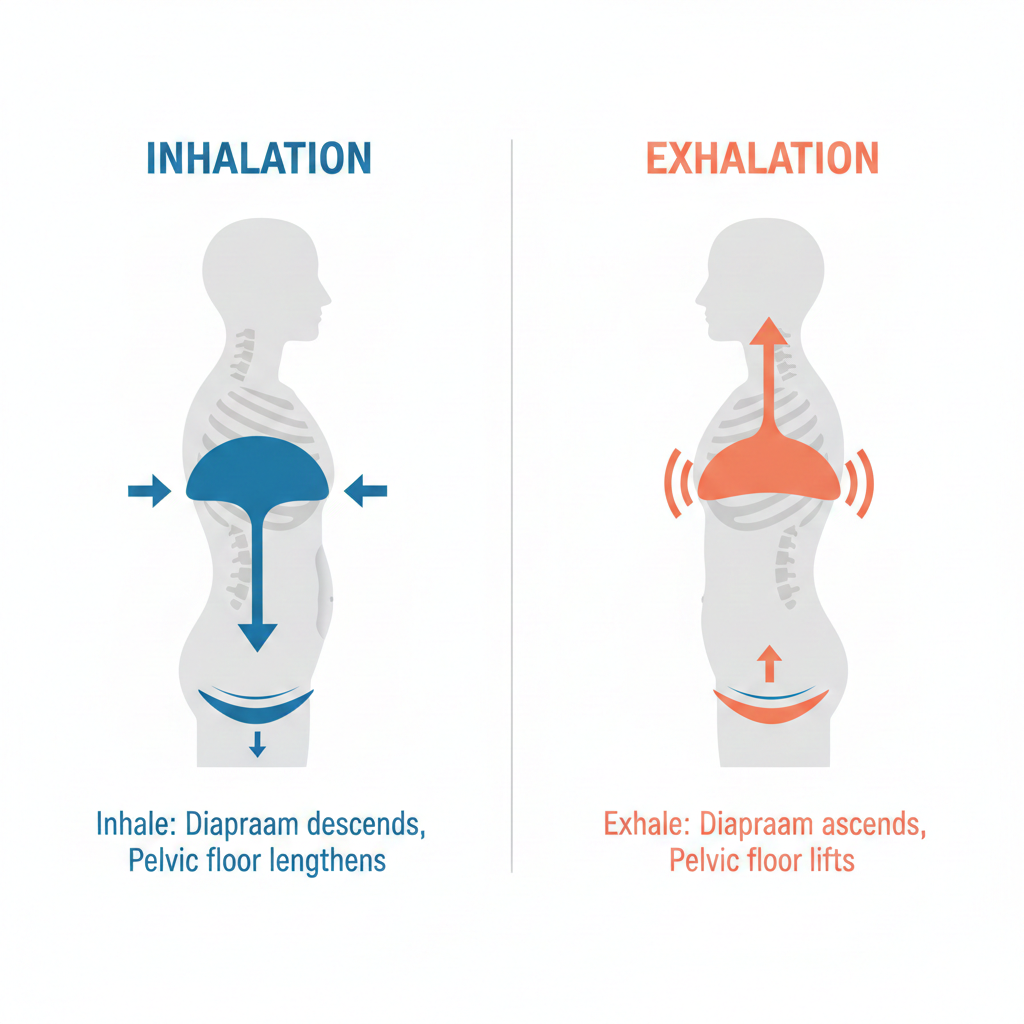
Here's how it works: when your diaphragm descends during inhalation, it increases pressure inside your abdominal cavity. Your pelvic floor responds by gently descending and lengthening. When you exhale, your diaphragm rises, your pelvic floor lifts, and your deep abdominal muscles naturally engage. This coordinated dance creates intra-abdominal pressure that stabilises your spine from the inside.
This is your body's built-in stabiliser. It's supposed to happen automatically with every breath, providing constant support for your spine during all activities. But here's the problem: most people breathe primarily into their upper chest, or they hold their breath during exercises, completely bypassing this stabilisation system.
:::warning Shallow breathing or breath-holding during exercises undermines stability. When you hold your breath during a plank or lift, you're creating rigidity instead of responsive stability. Your spine needs dynamic support that adapts to movement, not a rigid brace. :::
When you shallow breathe, your shoulders and neck muscles take over, your diaphragm barely moves, and your pelvic floor doesn't get the signal to respond. You've essentially disconnected your body's primary stabilisation system. Just aiming to belly breathe also makes it hard for your diaphragm and pelvic floor to activate well. No amount of planks will fix a breathing pattern that's working against your core stability.
Why Starting with Planks Often Fails
Planks aren't a bad exercise. They're just the wrong starting point for most people, especially those dealing with back pain. Here's why: planks require your deep core to already be functioning properly. They don't teach deep core activation—they test it.
In my experience with similar presentations, people with back pain often can't access their deep core during complex positions like a plank. Instead, they compensate. They hold their breath to create rigidity. They squeeze their glutes excessively. They tense their shoulders and neck. They're working hard, shaking, feeling the burn—but they're not actually training the stabilization system that needs attention.
:::tip If you're holding your breath during a plank, you're training compensation patterns, not core stability. True core stability maintains coordinated breathing throughout the exercise. :::
These compensation patterns don't just make the exercise less effective—they actually reinforce the dysfunctional patterns that contribute to back pain in the first place. You're practicing the wrong thing, getting better at moving in ways that stress your spine instead of protect it.
Think about it this way: if someone can't maintain proper breathing and pelvic floor coordination while lying on their back, asking them to do it while holding their body weight in a plank position makes no sense. You're building a house starting with the roof instead of the foundation. The structure might look impressive for a moment, but it won't hold up under real-world demands.
The Right Starting Point: Breathing and Pelvic Floor Activation
Let's get practical—here's what you can do about this. The right starting point is establishing 360-degree breathing: your ribs should expand in all directions (front, sides, and back), and your belly should rise gently. This isn't just chest expansion or belly breathing alone—it's complete, three-dimensional expansion of your torso.
Start lying on your back with knees bent, feet flat. Place one hand on your chest and one on your belly. As you inhale through your nose, feel your ribs expand to the sides and your belly gently rise. Your upper chest should move last and least. As you exhale through your nose, feel everything gently deflate. Practice this for 5-10 breaths, focusing on the expansion pattern rather than breathing deeply.
:::tip The pelvic floor should move with your breath: gently descending on inhale, lifting on exhale. Think of it as a soft elevator, not a hard squeeze. Many people over-engage initially, which creates tension instead of coordination. :::
Once you can maintain this breathing pattern consistently while lying down, progress to seated, then standing. Each position change increases the challenge because your core has to work harder against gravity. This might take days or weeks—and that's completely normal. What we know about tissue healing is that motor control comes before strength. You're teaching your nervous system a new pattern, which takes time and repetition.
How do you know when you're ready to progress? You should be able to maintain 360-degree breathing for 10-15 breaths without reverting to shallow breathing, in all three positions (lying, seated, standing). You should feel your pelvic floor gently responding to your breath without having to force it. And you should be able to do this while having a conversation—it needs to feel natural, not like a complex task requiring all your attention.
The Progression Pathway: From Breathing to Dynamic Core Control
Once you've established the foundation, here's how to build on it systematically. This progression typically takes 6-12 weeks, though individual timelines vary based on your starting point and consistency.
Phase 1 (weeks 1-2): Establish breathing and pelvic floor awareness. Practice 360-degree breathing in various positions. Focus on feeling the coordinated response between your diaphragm and pelvic floor. This phase might feel too simple, but it's essential. You're rewiring neural pathways.
Phase 2 (weeks 3-4): Maintain deep core activation during simple movements. Try dead bugs: lying on your back, maintain your breathing pattern while slowly lowering one arm overhead and the opposite leg toward the floor. Or bird dogs: on hands and knees, extend opposite arm and leg while keeping your breath steady. The movement is secondary—maintaining breathing coordination is primary.
:::keytakeaway The research consistently shows that motor control training before strengthening reduces recurrence of back pain. You're not just building strength—you're teaching your body to protect itself automatically. :::
Phase 3 (weeks 5-8): Progress to holds and anti-rotation exercises. Now planks make sense because you can maintain your breathing and deep core activation throughout. Add pallof presses: resisting rotation while maintaining core stability. These exercises challenge your ability to maintain stability while external forces try to disrupt it.
Phase 4 (weeks 9-12 and beyond): Integrate into functional movement and daily activities. Practice maintaining core activation while lifting groceries, picking up your kids, or doing yard work. This is where the real benefit appears—not in how long you can hold a plank, but in how your body automatically stabilises during real-world demands. Your core becomes a responsive, adaptive system rather than a rigid brace.
Conclusion
Core training that starts with breathing instead of planks might seem counterintuitive, but it's actually how your body is designed to work. Your deep core system—the coordination between your diaphragm, pelvic floor, and deep abdominal muscles—provides the foundation for all movement and spinal protection.
When you skip this foundation and jump straight to complex exercises, you're likely reinforcing compensation patterns rather than building true stability. The result? You work hard, but back pain persists or returns because the underlying coordination problem was never addressed.
The good news? Establishing this foundation doesn't require expensive equipment or hours at the gym. It starts with something you're already doing thousands of times per day: breathing. When you learn to breathe in a way that engages your deep core system, you create the stable platform that makes all other core exercises more effective and all daily movements safer.
Start with breathing. Master the foundation. Then build on it systematically. Your back will thank you.