Joint Hypermobility: Why 'Floppy' Joints Need Strength, Not Stretching
If you've ever been told you're "naturally flexible" or can bend your joints in ways that make others wince, you might have joint hypermobility. While it might seem like a party trick or an advantage in yoga class, hypermobility often comes with a hidden cost: pain, instability, and injury. Here's the counterintuitive truth I share with patients almost daily: if your joints are already too flexible, stretching more isn't the answer. In fact, it's often making things worse.
The solution isn't about gaining more range of motion—you already have plenty. It's about learning to control the range you have. Think of it like this: having hypermobile joints is like driving a car with loose steering. The problem isn't that the wheels don't turn far enough; it's that you can't control where they're going. What you need isn't a steering wheel that turns further—you need one that responds predictably to your input.
In this post, we'll explore why hypermobile joints need strength training, not stretching, and how to build the stability that protects your joints from injury. If you've been frustrated by recurring injuries despite being "so flexible," this might finally explain why.
Understanding Joint Hypermobility: What 'Floppy' Really Means
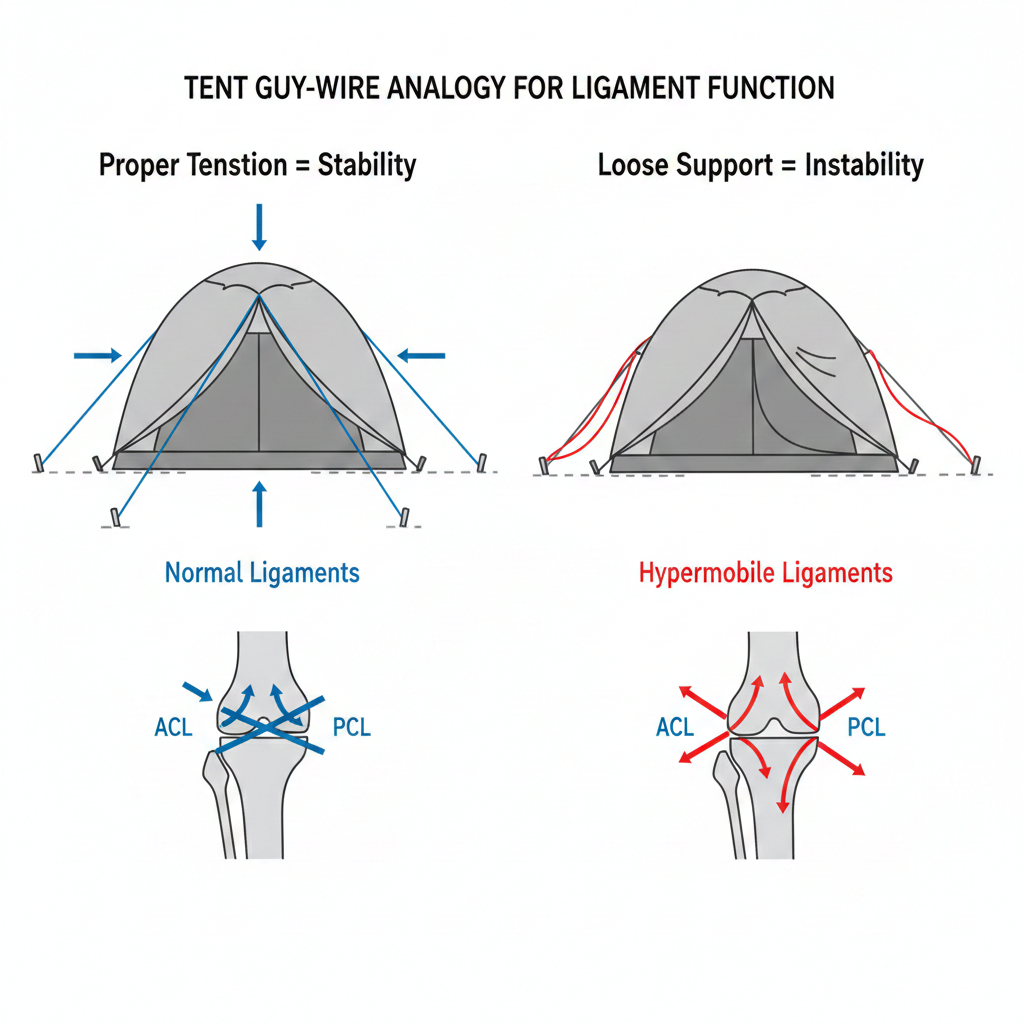
Let's start with what's actually happening in hypermobile joints. Joint hypermobility means your joints can move beyond the normal range of motion. This happens because of ligament laxity—your ligaments (the tough bands that connect bone to bone) are structurally looser than average. Think of ligaments as the guy-wires on a tent. When they're properly tensioned, the structure is stable. When they're loose, everything wobbles.
This ligament laxity is usually genetic. Your body produces collagen—the protein that gives ligaments their strength—in a slightly different way. The result is tissues that are more extensible, more elastic. While this isn't inherently problematic, it means your joints lack the passive stability that most people have. Your bones can move further apart, rotate more, and shift in ways that other people's joints simply can't.
:::note Hypermobility exists on a spectrum. Some people have one or two hypermobile joints; others have generalized hypermobility affecting most joints in their body. The Beighton Score is a simple clinical test that assesses hypermobility at nine sites. :::
I often describe hypermobile joints as 'floppy' to patients because it captures the real issue: lack of control. Your joints aren't just flexible—they're unstable. Without the structural support from tight ligaments, your muscles have to work overtime to keep your joints in the right position. When those muscles get tired or aren't strong enough, your joints drift into extreme ranges where they're vulnerable to injury. The problem isn't that you can't touch your toes—it's that you can put your palms flat on the floor without bending your knees, and your body doesn't quite know how to handle that much range safely.
The Stretching Paradox: Why More Flexibility Makes Things Worse
Here's where things get counterintuitive. Most people assume that if something feels tight, they should stretch it. But for hypermobile individuals, that "tight" feeling is often your muscles desperately trying to stabilize joints that are moving too much. When you stretch those muscles, you're removing the only stability mechanism you have left.
The research on tissue tolerance tells us that joints need a certain amount of stiffness to function optimally. When ligaments are lax, that stiffness has to come from somewhere else—namely, your muscles and the nervous system's ability to control them. By adding more flexibility through stretching, you're essentially loosening an already loose system. It's like loosening the bolts on a wobbly chair and expecting it to become more stable.
:::warning Many hypermobile people are drawn to activities like yoga, Pilates, and gymnastics because they're naturally good at them. However, without proper modifications, these activities can worsen joint instability by repeatedly pushing joints to their end ranges without building the strength to control those positions. :::
I see this pattern constantly in my practice: someone with hypermobility starts yoga to help with back pain, feels good initially (because movement is generally beneficial), but over time develops more pain and instability. They're unknowingly training their joints to go further into ranges they can't control. What feels like "opening up" is actually creating more instability. The temporary relief from movement is real, but the long-term effect is problematic. Your joints don't need more range—they need better control of the range they already have.
What Hypermobile Joints Actually Need: Stability Over Stretch
The solution is motor control—teaching your muscles to actively control your joint range. This is fundamentally different from passive flexibility. Passive flexibility is what happens when someone pushes your leg toward your head or when you sink into a deep stretch. Active control is your ability to move your joint through that range with strength and precision, then hold it steady.
From a movement perspective, strength training is protective for hypermobile joints because it does three critical things. First, it builds the muscular endurance needed to keep joints stable throughout the day. Second, it teaches your nervous system to recognize and avoid vulnerable joint positions. Third, it creates active stiffness—the ability to control and limit motion when needed, rather than relying solely on passive structures that aren't doing their job.
:::tip Think of active control like this: can you lift your leg to hip height and hold it there steadily for 30 seconds? That's active control. Being able to have someone lift your leg above your head while you're relaxed? That's passive flexibility. Hypermobile people usually have plenty of the latter but lack the former. :::
The difference matters enormously for injury prevention. When you have good motor control, your muscles can sense when a joint is approaching its end range and automatically engage to protect it. Without that control, you repeatedly stress your joints in vulnerable positions—during everyday activities, not just exercise. Over time, this leads to pain, inflammation, and sometimes structural damage to cartilage and other joint tissues. Building strength isn't about becoming a bodybuilder; it's about giving your joints the active support system they desperately need.
Practical Approach: Building Stability in Hypermobile Bodies
So how do you actually build this stability? The key principles are different from standard strength training. First, focus on end-range strengthening—building strength at the outer limits of your joint range where you're most vulnerable. This means exercises that challenge you to control positions near your maximum range, not exercises that push you further into that range.
Eccentric control is particularly important. This is your ability to slowly lower or lengthen under load. For example, if you're doing a squat, the eccentric phase is the lowering down portion. For hypermobile individuals, this controlled lowering teaches the nervous system to put the brakes on movement, which is exactly what you need. Your muscles learn to decelerate and control motion rather than just moving through space.
:::tip Avoid locking out or hyperextending joints during exercise. If you have hypermobile elbows, don't fully straighten your arms during planks or push-ups. If your knees hyperextend, maintain a micro-bend during standing exercises. This keeps your muscles engaged rather than hanging on passive structures. :::
Controlled movements trump heavy weights. You're better off with lighter resistance and perfect form than heavy weights with joints drifting into extreme positions. Think slow, deliberate, controlled. If you're shaking or losing position, you've gone too heavy or too far. Building endurance matters more than maximum strength—your muscles need to stabilize your joints all day long, not just during a one-rep max.
Here are some beneficial exercises: banded walks (builds hip stability), wall slides with a slight bend in the elbows (shoulder control without hyperextension), single-leg stands progressing to single-leg deadlifts (ankle and knee stability), and planks with active shoulder protraction (keeping shoulder blades apart, not sagging between them). Exercises to modify or avoid: deep stretching in yoga poses, pushing into maximum joint ranges, ballistic or bouncing movements, and exercises where you're "hanging" on joints in locked-out positions.
The goal isn't to never use your full range of motion—it's to use it with control and strength. You can still do activities you enjoy, but with modifications that protect rather than stress your joints. This might mean not sinking into your deepest split in yoga, keeping a micro-bend in your elbows during chaturanga, or focusing on muscle engagement rather than how far you can reach.
Red Flags and When to Seek Professional Help
While many people with hypermobility can manage well with appropriate exercise, some signs indicate you need professional assessment. Frequent injuries—sprains, strains, or dislocations that happen with minimal trauma—suggest your joints need more support than self-management can provide. Chronic pain that doesn't improve with strengthening, or pain that moves around your body, may indicate a hypermobility spectrum disorder.
Joint subluxations (partial dislocations where the joint slides out of place then back in) are a significant red flag. If your shoulders, kneecaps, or other joints regularly slip out of position, you need assessment by a physiotherapist or physician familiar with hypermobility. These episodes can cause cumulative damage over time.
:::warning Some people with hypermobility have Ehlers-Danlos Syndrome (EDS) or Hypermobility Spectrum Disorders (HSD), conditions that involve multiple body systems beyond just joints. If you have hypermobility plus frequent bruising, digestive issues, chronic fatigue, or skin that's unusually stretchy or fragile, discuss these symptoms with your doctor. :::
Self-management through appropriate strengthening works for many people with hypermobility. But if you're experiencing significant pain, frequent injuries, or symptoms beyond joint looseness, seek help from a healthcare provider experienced in hypermobility conditions. The right support can make an enormous difference in your quality of life.
Conclusion
If you have hypermobile joints, the path forward isn't more flexibility—it's building the strength and control to manage the range you already have. This shift in thinking can be liberating. You don't need to stretch more, bend further, or prove your flexibility. You need to build a muscular support system that protects your joints from the instability that comes with loose ligaments.
Start with the principles we've covered: controlled movements, end-range strengthening, avoiding hyperextension, and building muscular endurance. Progress gradually. Your body has been managing with loose joints for years, and it will take time to build new patterns of stability and control. Be patient with the process.
The research consistently shows that appropriate strength training reduces pain and improves function in people with hypermobility. You're not broken, and you're not destined for chronic pain. You just need to work with your body's unique structure rather than against it. Strength, not stretching, is your path to feeling better and moving with confidence.