Why Rotator Cuff Pain Travels Down Your Arm (Not Where You'd Expect)
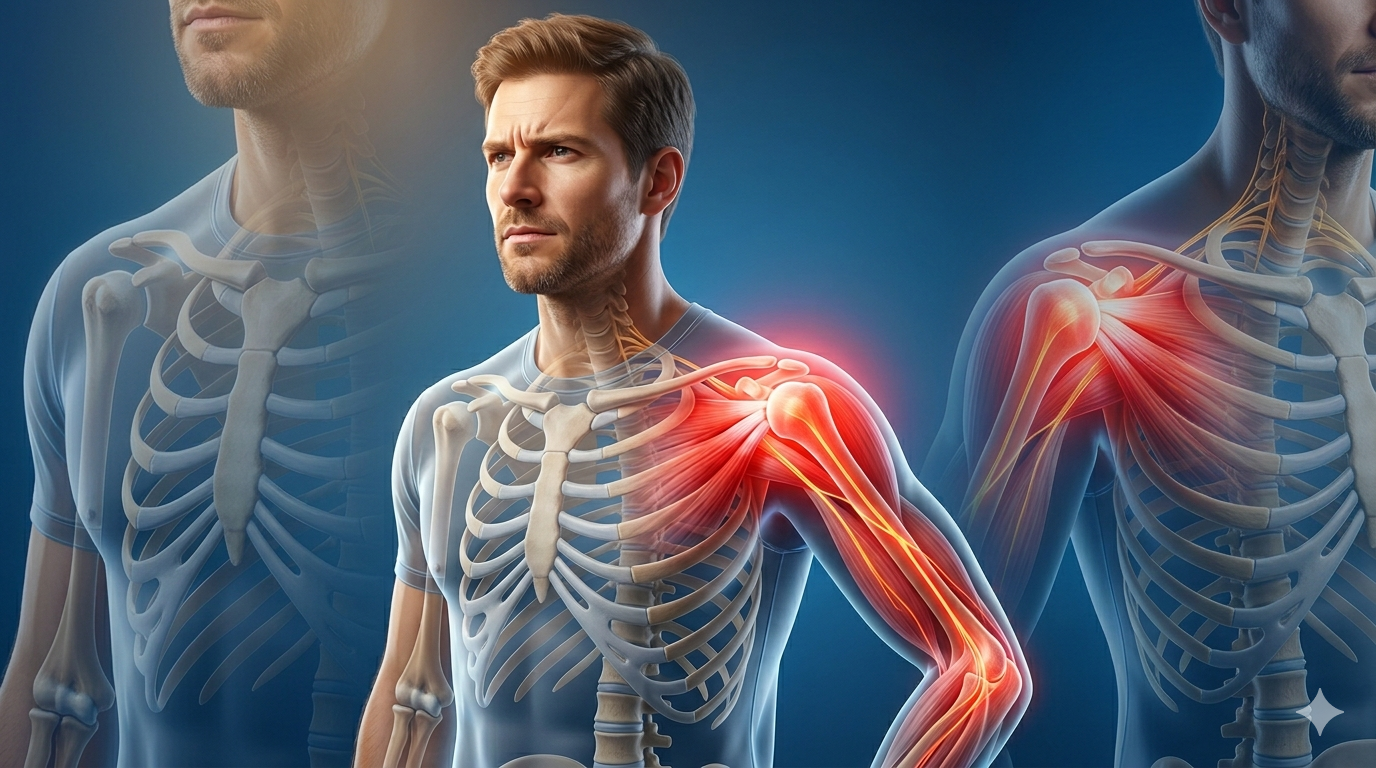
You're probably reading this because you have shoulder pain that doesn't quite make sense. Maybe you've been told you have a rotator cuff problem, but the worst pain isn't in your shoulder at all—it's halfway down your arm. You might be wondering if the diagnosis is wrong, or if you have two separate injuries. Here's the truth: what you're experiencing is completely normal for rotator cuff injuries. In fact, arm pain is one of the most common presentations I see in clinical practice. The disconnect between where the injury is and where you feel the pain confuses many people, but once you understand why it happens, everything starts to make sense. Let's break down exactly why your rotator cuff pain travels down your arm, and what this means for your recovery.
The Rotator Cuff Mystery: Why Your Shoulder Pain Lives in Your Arm
Most people expect rotator cuff pain to be felt directly in the shoulder muscles themselves. It seems logical—if the rotator cuff is injured, shouldn't the pain be right there in the shoulder?
In reality, pain commonly radiates down the upper arm, often settling around the middle of the upper arm or even extending toward the elbow. This pattern confuses many patients, who assume they must have a separate arm injury or that their shoulder diagnosis is incorrect.
:::note Rotator cuff pain typically presents in the upper arm, not the shoulder muscles. This is a feature of the injury, not a sign of misdiagnosis. :::
Understanding this pattern is actually crucial for recognizing legitimate rotator cuff issues. When you know that arm pain is expected, you can focus on the right treatment approach rather than chasing phantom diagnoses. The research consistently shows that pain referral patterns are one of the most reliable indicators of rotator cuff pathology.
Meet Your Rotator Cuff: Four Muscles with One Critical Job
Before we dive into pain patterns, let's get clear on what the rotator cuff actually is. Your rotator cuff consists of four relatively small muscles: supraspinatus, infraspinatus, teres minor, and subscapularis. These muscles originate on your shoulder blade and wrap around the head of your upper arm bone like a cuff—hence the name.
Their primary role isn't to move your arm in big, powerful motions. Instead, they stabilize the shoulder joint during movement. Think of them as the fine-tuning system that keeps your upper arm bone centered in the shallow shoulder socket while your larger muscles (like the deltoid) do the heavy lifting.
:::tip Your rotator cuff muscles work as a coordinated team to create a stable platform for arm movement. When one muscle is injured, the entire system becomes less effective. :::
These muscles work as a coordinated team, not individual actors. When you raise your arm overhead, all four muscles activate in a precise sequence to compress the joint and prevent the upper arm bone from jamming into the shoulder socket. This coordinated action is why even a single injured rotator cuff muscle can create widespread dysfunction—the team can't perform properly when one member is compromised.
The Pain Paradox: Why Injury Location ≠ Pain Location
Here's a fundamental principle of pain science that explains your confusing symptoms: pain doesn't always originate where you feel it. This isn't unique to rotator cuff injuries—it's a feature of how your nervous system processes and reports pain signals.
Two distinct mechanisms cause arm pain in rotator cuff injuries, and understanding both helps you make sense of what you're experiencing. The first involves nerve irritation and referred pain patterns. The second relates to where rotator cuff tendons actually attach to bone.
:::keytakeaway The location where you feel pain is not always the location of tissue damage. Your brain interprets pain signals based on complex neural pathways, not simple one-to-one mapping. :::
Both mechanisms can be active simultaneously in the same injury, which is why rotator cuff pain often feels diffuse and hard to pinpoint. Let's break down each mechanism so you understand exactly what's happening in your shoulder.
Mechanism #1: Nerve-Based Referred Pain
When rotator cuff muscles become inflamed or injured, the swelling doesn't stay neatly contained within the muscle tissue. Inflammation can spread to nearby structures, including nerves that pass through the shoulder region.
The nervous system interprets these irritated nerve signals as coming from the areas those nerves supply—which includes your upper arm. This is called referred pain, and it's the same mechanism behind why heart attacks can cause left arm pain or why gallbladder problems can create shoulder pain.
From a movement perspective, this makes clinical sense. The nerves that supply sensation to your rotator cuff muscles share pathways with nerves supplying your upper arm. When inflammation irritates these shared pathways, your brain can't always distinguish the exact source of the signal.
:::note Referred pain is not 'imaginary' or 'all in your head.' It's a real phenomenon based on how nerve pathways are organized in your body. :::
This is why anti-inflammatory treatments often help both shoulder and arm pain simultaneously—they're addressing the root cause of nerve irritation, which reduces pain signals along the entire pathway.
Mechanism #2: Tendon Insertion Point Pain
The second mechanism is more anatomically straightforward. Your rotator cuff muscles don't just float in your shoulder—they attach to bone via tendons. Specifically, these tendons insert at the top of your humerus, which is your upper arm bone.
When rotator cuff tendons are injured, inflamed, or degenerating, the pain is often felt most intensely at this insertion point. This creates a distinct 'hot spot' of pain in your upper arm, typically on the outer aspect, rather than in the shoulder muscles themselves.
:::tip Press gently on the outer upper arm, about 4-6 inches below your shoulder. If this reproduces your pain, you're likely feeling tendon insertion point tenderness—a classic rotator cuff sign. :::
This insertion point pain can be particularly intense during certain movements or when you press on the area. It's why many people with rotator cuff injuries can't sleep on the affected side—the pressure directly compresses these inflamed tendon insertions. Understanding this helps explain why treatments targeting the shoulder muscles alone may not fully resolve your arm pain.
What This Means for Your Recovery
Don't dismiss arm pain as unrelated to your shoulder problem. In fact, if you have confirmed rotator cuff pathology and arm pain, they're almost certainly connected. Treating them as separate issues will only delay your recovery.
Both pain patterns—nerve-based referred pain and tendon insertion point pain—can coexist, and they often do in rotator cuff injuries. This is why your pain might feel diffuse, hard to localize, and variable from day to day. You're not imagining the complexity; there genuinely are multiple mechanisms at play.
:::warning If your arm pain is accompanied by numbness, tingling, or weakness that extends below the elbow, consult a healthcare provider. These symptoms may indicate nerve compression requiring different management. :::
Understanding pain location helps guide treatment and set realistic expectations. Effective rotator cuff rehabilitation addresses both the source of inflammation and the mechanical factors contributing to tendon stress. As your shoulder function improves, both shoulder and arm pain typically decrease together—because you're addressing the root cause, not just chasing symptoms.
Conclusion
Your arm pain isn't a mystery or a sign that something else is wrong—it's a predictable feature of how rotator cuff injuries present. Whether through nerve-based referred pain, tendon insertion point tenderness, or both mechanisms combined, arm pain is one of the most common symptoms I see in rotator cuff cases. This knowledge changes how you approach recovery. Instead of worrying that you have multiple unrelated problems, you can focus on comprehensive shoulder rehabilitation that addresses the true source of your symptoms. As inflammation decreases and shoulder mechanics improve, both your shoulder and arm pain will typically improve together. The key is understanding that your body's pain signals, while confusing, are actually giving you valuable information about what's happening beneath the surface. Trust the process, focus on evidence-based rehabilitation, and know that arm pain in rotator cuff injuries is normal, expected, and treatable.